You're exercising regularly, pushing yourself through challenging workouts, and trying to eat healthy. You're doing everything you think you're supposed to do to lose weight. So why aren't you seeing results? Maybe you're wondering whether you need to exercise harder, longer, or more often.
After performing thousands of metabolic tests since 2008, I've discovered something that surprises many of my clients: They're often working out harder than they need to—and sometimes at heart rates that aren't ideal for their goals. They may also be eating too little to support the intensity of their workouts.
That's where VO₂ and Metabolic Exercise Testing can make a difference. Instead of relying on generic heart-rate formulas or guessing how hard you should exercise, we can measure how your body responds at different intensities and use that information to create a more personalized training plan. Let me explain what I've learned, what the testing reveals, and how it can help you make the most of your workouts.
Can VO₂ Testing Really Help You Lose Weight?
Yes! VO₂ testing can be a valuable tool for people trying to lose weight, particularly if they're already exercising consistently but aren't seeing the results they expect.
But there's something important to understand: The test itself doesn't cause weight loss. It helps us understand how your body responds to exercise so we can make smarter decisions about your training.
VO₂ refers to the amount of oxygen your body uses during exercise. VO₂ max is a measure of your body's maximum capacity to use oxygen during increasingly demanding activity, and it's an important indicator of cardiovascular fitness.
The testing equipment I use does much more than measure oxygen consumption.
It also measures the carbon dioxide you produce as you exercise. That allows us to examine how your body uses fat and carbohydrates for energy at different intensities and identify important training thresholds.
In other words, we can learn more than how fit you are.
We can learn how to train more effectively for your particular goals, whether that's losing weight, improving endurance, running a faster mile, or simply feeling better during your workouts.
And sometimes, what we discover is that you don't need to work harder at all.
You need to work differently.
Why Working Out Harder Isn't Always Better
One of the biggest mistakes I see people make when trying to lose weight is assuming that more intensity automatically means better results.
We've been taught that a good workout should leave us exhausted, drenched in sweat, and feeling like we gave absolutely everything we had.
And while challenging workouts certainly have their place, not every workout needs to feel that way.
In fact, many of the people I test are spending too much time exercising at higher intensities without enough lower-intensity training or recovery.
Some are also under-eating relative to how hard they're exercising.
That combination can leave people feeling tired, frustrated, and unable to maintain their training consistently.
The Importance of Building Your Aerobic Base
Your aerobic system helps your body produce energy using oxygen. It's especially important for activities you can sustain over longer periods, such as walking, jogging, cycling, and other endurance exercise.
Lower-intensity aerobic training helps develop that system.
Over time, appropriate aerobic training can improve your endurance, support adaptations in your mitochondria (the structures in your cells that help produce energy), and make it easier to sustain more demanding exercise.
That's why I often recommend a combination of lower-intensity workouts and carefully planned higher-intensity intervals.
The right balance depends on your fitness level, your goals, and how your body responds.
I love seeing the surprise on someone's face when I explain that slowing down during some workouts may actually help them improve their overall fitness.
For many clients, that's a completely different way of thinking about exercise.
What Does a VO₂ and Metabolic Exercise Test Actually Measure?
Most people have heard of VO₂ max testing, especially if they own a fitness watch or follow endurance sports.
But the testing I provide goes beyond a single VO₂ number.
My metabolic testing equipment measures both oxygen consumption and carbon dioxide production as your exercise intensity increases.
This allows us to examine several important aspects of your fitness.
Your VO₂ Max or Peak VO₂
This measures how much oxygen your body can use during increasingly intense exercise.
A higher VO₂ value generally indicates greater aerobic fitness, although results should be interpreted in the context of your age, sex, and other individual factors.
When someone reaches a true maximal effort, we may be able to measure VO₂ max. Otherwise, the highest value achieved during the test is more accurately described as peak VO₂.
Either way, the information gives us a useful starting point for understanding cardiovascular fitness and monitoring progress.
Your Aerobic Threshold
Your aerobic threshold is an important point in your body's response to increasing exercise intensity.
It's useful for identifying training intensities that help develop your aerobic endurance.
This is particularly valuable for people who are constantly pushing themselves during cardio workouts without spending enough time building their aerobic base.
Your Anaerobic Threshold
As exercise becomes more demanding, your body increasingly relies on carbohydrates to help meet its energy needs.
Your anaerobic threshold helps us identify the transition toward more demanding exercise intensities that become harder to sustain.
Understanding where this occurs can help us plan more challenging workouts and intervals appropriately.
Your Fat and Carbohydrate Utilization
Here's one of my favorite parts of the testing.
Because my equipment measures carbon dioxide as well as oxygen, we can calculate something called your Respiratory Exchange Ratio (RER).
RER helps us estimate the proportion of fat and carbohydrates your body is using for energy at different exercise intensities.
During your test, you'll see a chart showing how those estimated proportions change as your heart rate increases.
For many clients, this is the most eye-opening part of the experience!
They discover that their body is using a higher proportion of fat for energy at lower heart rates than they expected.
Now, that doesn't mean there's one magical fat-burning heart rate that guarantees weight loss. Your body uses a combination of fuels, and long-term fat loss depends on your overall nutrition, energy balance, activity, and other factors.
But understanding your fuel utilization and training thresholds can help us develop a much more individualized exercise strategy.
Are Your Fitness Watch's Heart-Rate Zones Accurate?
Fitness watches can be wonderful tools. I love that they encourage people to move more, monitor their activity, and pay attention to their health.
But there's a difference between an estimated heart-rate zone and one based on your individual physiological responses.
Many watches and fitness programs use age-based formulas to estimate maximum heart rate and calculate training zones.
Those formulas can provide a reasonable starting point, but they don't necessarily reflect your personal aerobic and anaerobic thresholds.
And in my experience, the estimated zones are often higher than the thresholds we identify during testing.
That means someone may think they're exercising in a moderate training zone when they're actually working at a more demanding intensity.
What About Orangetheory Fitness?
I've worked with quite a few Orangetheory clients over the years.
Many come to me because they're working incredibly hard in class but aren't getting the results they expected.
They assume they need to push harder or spend more time in the higher-intensity zones.
But after testing, we sometimes discover that their individual training zones don't line up with the zones being used in class.
One client, Rachel, was particularly surprised.
Her testing revealed that the heart-rate ranges she associated with Orangetheory's Blue and Green zones didn't correspond to the same exercise intensities in her own body.
Based on her results, I recommended that she adjust her workouts and spend more time training at lower intensities.
Here's what she told me afterward:
"I can't believe it, I'm working out way less intense and the pounds are dropping! This is the craziest thing, but you're right, it's working! Thank you!"
— Rachel
I love this story because it illustrates something I tell clients all the time:
You don't have to exhaust yourself to make progress.
You need a workout strategy that makes sense for your body.
A Real Client Story: Better Fitness, More Energy, and 10 Pounds Lost
Another client came to me because he was exercising consistently, trying to eat healthy, and feeling frustrated with his weight-loss progress.
He was 30 years old and typically performed his cardio workouts at around 140 beats per minute.
He thought he was training at an appropriate intensity.
But when we performed his VO₂ test, we discovered something interesting.
His measured aerobic threshold was approximately 114 beats per minute, and his anaerobic threshold was around 148 beats per minute.
His VO₂ result was 27.7, which fell into the very low fitness category for his age using the reference standards we applied.
Instead of telling him to exercise harder, we changed his training program.
I recommended that he spend two workouts per week developing his aerobic base in Zone 2, using his measured thresholds to guide the intensity.
For his other workouts, we incorporated shorter intervals at higher intensities, including Zones 3–5, according to his ability and goals.
The idea was to give his body different training challenges instead of continually working at roughly the same intensity.
His Results After Eight Months
When we retested him eight months later, the improvements were wonderful.
He had lost 10 pounds.
His aerobic threshold increased from 114 to 134 beats per minute.
His anaerobic threshold increased from 148 to 151 beats per minute.
His VO₂ increased from 27.7 to 36.3—an improvement of approximately 31%.
His fitness classification improved from very low to fair using the same reference standards.
But the numbers weren't the only improvement.
He also reported having more energy throughout the day, experiencing less fatigue, and recovering more easily after workouts.
Those are the kinds of changes that make me love what I do.
His results were individual, and weight loss depends on more than exercise intensity alone. But testing gave us a way to personalize his training, monitor his progress, and make informed adjustments along the way.
Who Benefits Most From VO₂ Testing?
You don't need to be a competitive athlete to benefit from VO₂ testing.
In fact, many of the people I work with are simply trying to improve their fitness, lose weight, or feel better.
I especially recommend considering VO₂ and Metabolic Exercise Testing if:
You're exercising regularly but struggling to lose weight.
You've reached a plateau in your fitness or weight-loss progress.
You're starting a new exercise program and want to establish personalized training zones.
You attend Orangetheory or another heart-rate-based fitness program and want to understand your actual training intensities.
You're preparing for a race, endurance event, or other athletic goal.
You want to improve your cardiovascular fitness without constantly pushing yourself to exhaustion.
You're curious whether your fitness watch's estimated heart-rate zones are appropriate for you.
You want objective measurements to help track your progress over time.
Whether you're a beginner or an experienced exerciser, having more individualized information can help you make better decisions about your workouts.
What Happens During a VO₂ Test?
If you've never had a VO₂ test before, you may be wondering what the appointment involves.
The good news is that the process is straightforward, and I'll guide you through it from beginning to end.
I perform testing at my private gym in Castle Rock, Colorado, so you won't be walking into a large, crowded fitness facility.
Before Your Appointment
I ask clients to arrive having fasted for at least three hours before testing.
When you book, I'll provide the preparation instructions so you know what to expect.
During the Test
You can choose the exercise equipment that works best for you:
Treadmill
Stationary bike
Elliptical
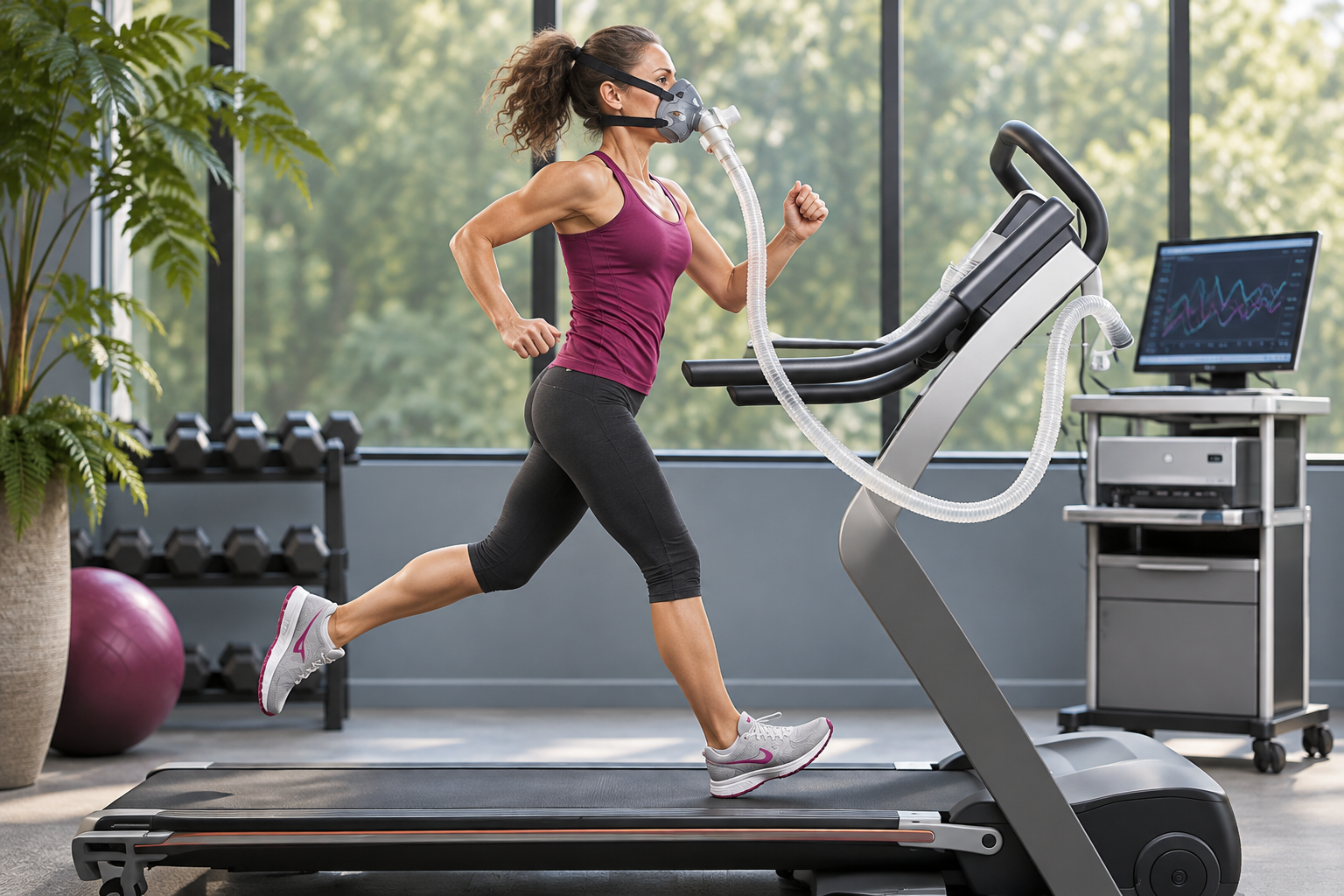
You'll wear a mask that allows the equipment to measure your breathing gases while we also monitor your heart rate.
We begin with an easy warm-up and gradually increase the exercise intensity, usually about once per minute.
This allows us to observe how your body responds as the workout becomes more demanding.
Toward the end, you'll have the opportunity to work toward your peak effort, as appropriate for your fitness level and ability.
Then we'll finish with approximately two minutes of cooldown.
The exercise test itself typically takes around 12–15 minutes.
After Your Test
This is where things get really interesting!
We'll review your printed results together, including the chart showing how your estimated fat and carbohydrate utilization changed throughout the test.
We'll also discuss your aerobic threshold, anaerobic threshold, VO₂ result, heart-rate zones, and recovery information.
Then I'll ask about your goals.
Are you trying to lose weight? Improve your endurance? Run a faster mile? Feel less exhausted during your workouts?
Based on your results and what you're hoping to accomplish, I'll recommend how to structure your training.
I'll also send you a follow-up email with your results and personalized workout recommendations so you can put the information into practice.
My goal isn't simply to give you a fitness score.
It's to help you understand what that score means and, more importantly, what to do next.
Should You Combine VO₂ Testing With Resting Metabolism Testing?
If your primary goal is weight loss, I often recommend combining VO₂ testing with Resting Metabolic Rate (RMR) testing.
Here's why.
VO₂ testing helps us understand the exercise side of your program.
We can identify your individual training thresholds, estimate fuel utilization at different intensities, and develop a more personalized workout strategy.
RMR testing helps us understand the nutrition side.
It measures how many calories your body burns at rest, giving us a more individualized starting point for determining your overall calorie needs and developing a nutrition plan.
When we combine the two, we get a more complete picture.
We can look at how you're fueling your body and how you're training it, rather than trying to solve a weight-loss plateau by changing only one thing.
I've worked with many people who were exercising intensely while eating too little to support their activity.
Having both sets of information can help us identify a more sustainable approach.
If you'd like to learn more about the nutrition side of metabolic testing, read my article, Can Metabolism Testing Help You Lose Weight?
You can also explore my RMR and VO₂ Testing Services to see how the two assessments work together.
How Much Does VO₂ Testing Cost in Castle Rock, Colorado?
I offer VO₂ and Metabolic Exercise Testing at my private gym in Castle Rock.
My current testing prices are:
VO₂ Testing: $150 — Includes exercise testing, a review of your results, individualized heart-rate training zones, and workout recommendations.
Combined VO₂ + RMR Testing: $225 — Includes both exercise testing and resting metabolism testing, saving you $50 compared with booking the tests separately.
I also offer 50% off retesting for clients who return to measure their progress.
I generally recommend considering a retest after approximately 12 weeks of consistent training, or when you've reached a plateau and your current workouts are beginning to feel easier.
Retesting can help us see how your cardiovascular fitness and training thresholds have changed.
And there's something incredibly motivating about seeing measurable improvements that reflect the hard work you've been putting in!
Why Choose Me for VO₂ and Metabolic Exercise Testing?
I've been performing metabolic testing since 2008 and have completed thousands of tests over the years.
My background includes personal training, nutrition, and years of helping clients understand how to exercise more effectively.
I began working with metabolic testing during my time at Life Time Fitness, where I learned how to use testing results to develop workouts that improve cardiovascular fitness and support clients' goals.
That experience has shaped the way I work with people today.
I don't believe in giving everyone the same generic exercise plan.
And I don't believe that working out harder is automatically the answer.
When you come to see me, I'll take time to understand your goals, explain your results in language that makes sense, and help you create a practical plan.
You'll also be tested in a comfortable, private gym rather than a large fitness center.
In addition to VO₂ testing, I offer RMR testing and other wellness services, so we can explore additional information when it's appropriate for your goals.
And if you'd like ongoing support with nutrition, exercise, and accountability, my 12-Week Transformation Program provides a more comprehensive coaching experience.
Ready to Stop Guessing and Start Training Smarter?
If you're working out consistently but not seeing the results you want, the answer may not be another harder workout.
It may be a better understanding of how your body responds to exercise.
VO₂ and Metabolic Exercise Testing can help you discover your individual training thresholds, understand your cardiovascular fitness, and develop a workout strategy based on your own physiology rather than generic estimates.
Whether you're trying to lose weight, improve your endurance, or simply make your workouts more effective, I'd love to help.
I offer testing by appointment at:
W8 4IT Gym
20 Wilcox St, Suite 111-B
Castle Rock, CO 80104
I welcome clients from Castle Rock, Parker, Highlands Ranch, Denver, and surrounding communities.
Learn More About VO₂ & Metabolic Exercise Testing
Let's find out what your body can tell us—and use that information to help you train smarter.